
The Dilemma of No-Kill Shelters
I recently saw this headline on what is ultimately a wonderful story about a greyhound who found a home:
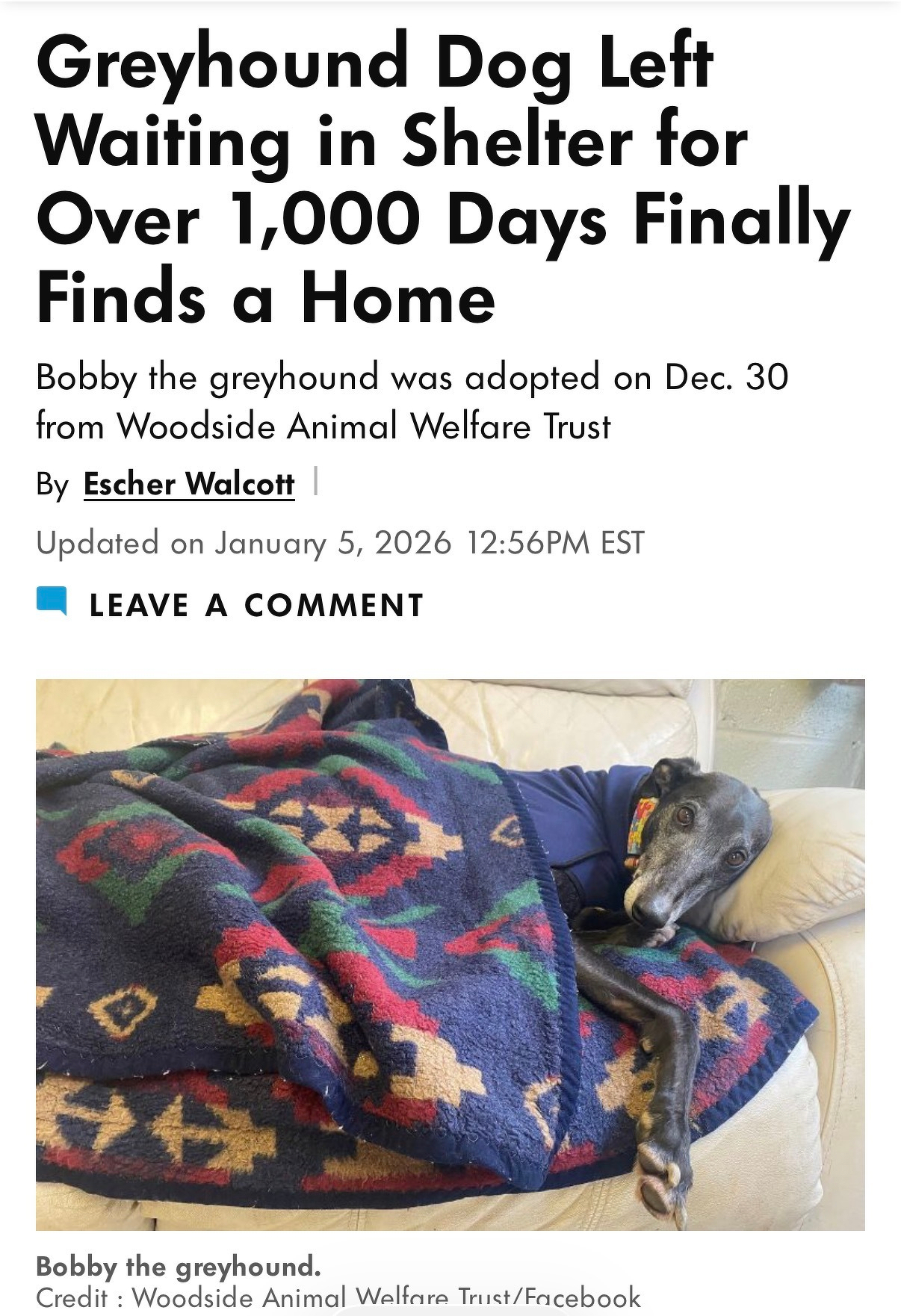 But what struck me is that Bobby waited in a shelter for almost 3 years. THREE YEARS, which is about a quarter of a dog’s life. That’s like 20 years for us.
I’ve volunteered with animal rescue organizations for decades, and I’ve always felt extremely conflicted about the concept of no-kill shelters, because some animals will, for whatever reason, have trouble getting adopted, and a no-kill policy means they may spend a signficant portion of their lives in a shelter. I saw this first-hand when I was volunteering at the Oakland SPCA (now the East Bay SPCA) and was coming back week after week to see some dogs who never seemed to get adopted, and started developing problematic behaviors: Pacing, compulsive licking, barking non-stop, seeming increasingly anxious. I assume they’re the same sort of issues humans develop in prison, especially if they’re in solitary confinement. Some of the dogs seemed to me like they were suffering, no matter how well they were treated by shelter staff and volunteers.
Obviously, environment matters, and some shelters are much more “home-y” with the dogs roaming freely in a shared play area most of the day. Some rescue groups place animals in home foster situations. But a lot of shelters keep dogs in small, concrete enclosures, often alone. Sure, they get a little bit of exercise and attention from staff and volunteers, but nowhere near what a dog deserves. Dogs are social animals, they want to share their lives with other beings (whether human or dog, or both, depends on the dog). If they’re kept in a shelter like that for years, is that a better outcome than putting them to sleep?
I’m not religious, and I approach animals' lives pragmatically: I don’t think a life of suffering is better than not being alive at all. If a tough life, like that of a street dog in Mexico, still includes many moments of joy and “regular” dog behavior, I think that’s probably a life worth living. But what about a life lived in a shelter for many years? Unfortunately, we can’t ask those dogs, which makes it that much harder.
And how to account for the fact that some of these dogs will end up like Bobby, in a shelter for a long time, but ultimately finding a safe and loving home? Does that make up for the years of imprisonment? In my mind, I think it does. But many of these dogs won’t get a happy ending, and we can’t know what will happen in advance.
I don’t have an answer here. I obviously think we should fund shelters so that they’re a positive environment for all the animals who need them, plus special initiatives to put the spotlight on dogs who have spent a long time waiting for adoption, but unfortunately, society doesn’t agree with me. I guess my motivation for posting this is because so many people view a “no-kill” shelter as an unmitigated positive, an ideal to which all shelters should aspire, and I wanted to point out that I don’t necessarily think that’s the case.
But I’m so happy for Bobby. He got the happy ending all dogs deserve.